“We don’t want more content… we want experiences”
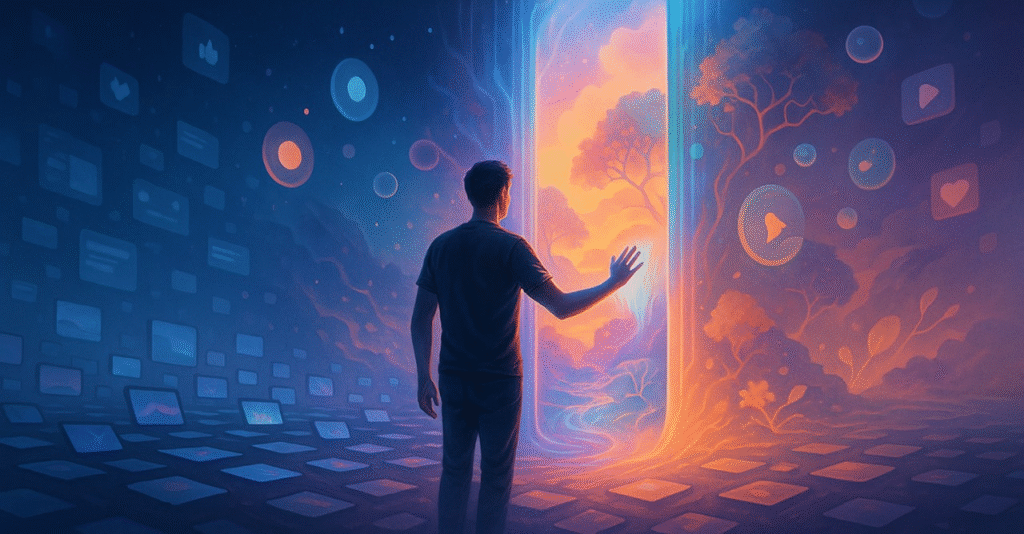
From endless scrolling to real connection: the new language of entertainment We live in an era where watching is no longer enough. In the midst of digital noise, people are searching for something that breaks the routine, that makes them want to interact, feel, participate. We don’t want more passive content; we want to be part of something. And that is completely changing the rules of the game in entertainment. For years, consuming meant sitting in front of a screen. Movies, series, commercials, even video games: everything followed a certain pattern. But today, the line between viewer and protagonist is blurring. And technology not only allows it, it’s driving it. Entertainment is no longer a product. It’s an experience. Entertainment, as we knew it, is undergoing a profound transformation. It’s no longer enough to produce visually striking or narratively solid content. Modern audiences curious, active, digital demand to live an experience, not just observe from the outside. This evolution is reflected in cultural and commercial phenomena that combine art, technology, and emotion in ways that once seemed exclusive to science fiction. Today, content is no longer a finished product handed over to the audience for passive consumption. Now, content is a starting point, a gateway to a universe people want to explore, shape, and remember. We see it constantly: concerts using augmented reality so the audience not only listens but participates; marketing campaigns that go beyond traditional videos, allowing users to explore virtual worlds from their mobile devices; interactive art installations, emotionally driven video games, and events where the viewer becomes the protagonist. These examples aren’t passing trends, they’re signs of a paradigm shift that’s just beginning. The future of entertainment isn’t about making longer content or adding more special effects. The real challenge is making it unforgettable. How? By creating experiences that can’t be replicated or copied, only lived firsthand. People no longer settle for watching. They want to enter the story. They want to touch it, walk through it, make decisions within it. The line between viewer and protagonist is fading. And all of this is possible thanks to one key factor reshaping the boundaries of creativity: technology. Creativity + Technology = Real magic When creativity meets technology, magic happens. But it’s not fantasy magic, it’s magic made of code, design, and interactive narrative. It’s the ability to turn abstract ideas into tangible digital realities, with textures, sounds, and paths users can explore at their own pace. New digital tools have opened up immense possibilities for creators, developers, and brands. Today, it’s not just about having a good idea, it’s about knowing how to build it so others can live it. Languages and frameworks like Three.js, Babylon, React Native, WebGL, or APIs specialized in augmented and virtual reality are no longer exclusive tools for tech developers. They’ve become the paintbrushes of a new generation of digital artists who combine storytelling, interaction, and visual design to build experiences. These tools don’t just make something “work” they come to life in creative hands, allowing ideas to transform into inhabitable worlds. Studios like HyperReality are at the forefront of this movement. They don’t just create games or apps, they build immersive environments tailored to each brand, project, or story. They work with brands that want to leave a mark on their audience, offering content where the user isn’t just a spectator but an active part of the experience. This is where programming becomes art, and strategy becomes emotion. Because in the end, what truly sticks in a user’s memory isn’t an image or a clever phrase. It’s a feeling, a sensation, a story in which they felt like the protagonist. And when that happens, the connection between brand and person transcends any metric. Immersion is the new standar Immersion is no longer a luxury reserved for big productions. It’s an expectation. People want content that speaks to them, surrounds them, surprises them. They want to step into a different universe for a few minutes and have that moment change the way they see a brand, a product, or a story. They want to remember the experience not just consume the message. Let’s ask ourselves: ¿What if your favorite movie was a 360° space where you choose where to begin? ¿What if a brand told its story through a video game where you shape the ending?¿What if education stopped being a PowerPoint and became an immersive experience where knowledge is actively explored? This isn’t science fiction, it’s the present. The technology and creativity are already here. What’s often missing is the willingness to take a bolder approach. Big ideas no longer fit in one format or on a flat screen. They are now designed to be explored to be lived from within. And that requires intentional design, layers of interactivity, and a deep understanding of human behavior in digital environments. Users want more than information. They want memories, moments they can share, repeat, and remember. That’s why immersion isn’t just a creative tool — it’s the new standard for engagement. If content doesn’t invite users to live it, it will likely be skipped in seconds. Creativity became interaction Gone are the days when creative content was just a collection of pretty visuals or catchy phrases. Today, creativity is measured by the ability to generate meaningful interaction. That’s why the brands truly making a difference are the ones that dare to break the mold, experiment, abandon linear storytelling, and hand control to the user. This shift demands a new mindset, one that thinks not in terms of campaigns, but in terms of shared experiences. One that understands it’s not about having the best product, but about crafting a story where the product plays a role in the user’s world. The most successful brands aren’t just the ones that “communicate well,” but the ones that build universes their audiences want to inhabit. And the most interesting part is that this doesn’t require huge budgets. What’s really needed is creative vision,
Artificial Intelligence: The technological breakthrough transforming marketing without replacing human talent

An ally of marketing and human talent Artificial Intelligence (AI): The Creative Industry’s Best Ally Artificial Intelligence (AI) has emerged as one of the most transformative technological innovations of the 21st century. From its academic roots to its practical implementation in the business world, AI has shown immense potential to reshape entire industries. Its ability to process large volumes of data, automate complex processes, and generate accurate real-time responses has redefined how companies, organizations, and even governments operate. Marketing Meets AI: A Natural Evolution Marketing—a discipline traditionally built on a blend of analysis, intuition, and creativity—has found in AI a powerful tool for evolution. Today, AI enables a deeper understanding of consumer behavior, personalization of content at scale, optimization of advertising investments, and campaign performance measurement with unprecedented precision. A Threat to Agencies? No, An Ally However, the rapid growth of AI has sparked some concern within the advertising ecosystem. Some brands, lured by the promise of reduced costs and faster processes, have started experimenting with these technologies independently. This has raised the question: could AI replace marketing agencies? The truth is, while AI can automate many tasks, it cannot replicate human talent, especially the kind found within an agency. Marketing agencies are not just service providers: they are environments where strategy, creativity, analysis, empathy, tactical execution, and innovation intersect. Agencies are made up of strategists, creatives, planners, designers, copywriters, community managers, analysts, account leaders, and more. Each brings a unique perspective, cultural sensitivity, and emotional intelligence that no algorithm can replicate. Moreover, an agency’s role goes far beyond task execution. It’s about building long-term relationships between brands and people, understanding culture, interpreting social contexts, identifying opportunities, and transforming them into powerful ideas that emotionally connect with audiences. AI, on its own, cannot conceptualize campaigns like Dove’s “Real Beauty,” Nike’s “Just Do It,” or Always’ “Like a Girl.” These successful campaigns were born from human insight, deep social understanding, and creative bravery not from a mathematical formula. AI + Creativity: The Real Advantage The future of marketing is not one where machines replace people, but one where human talent and AI coexist to achieve more ambitious results. The key lies in understanding how to integrate AI without losing what makes an agency unique: its strategic vision, its creativity, and its ability to connect with people. When used with purpose, AI doesn’t replace. It complements. It enhances. It empowers. And in the right hands, it can become the best ally of creative thinking. Strategic Integration of AI: The Case of Shifu A clear example of how an agency can turn a technological breakthrough into a valuable tool is Shifu, the app created by Hyperreality Company—an agency specialized in advertising experiences and services. Shifu is not just another app; it’s a productivity platform designed for creative teams. Through its intelligent interface, it helps organize ideas, tasks, resources, and workflows, incorporating automation to speed up internal processes without losing the human touch. This app is a testament to how an agency can embrace AI to enhance operational efficiency while preserving its creative essence. Instead of fearing change, they adopted it, adapted it, and transformed it into a proprietary solution that strengthens their work culture,
