

The success of AR and VR
Introduction
In the digital age, capturing and maintaining consumer attention is the biggest challenge. Engagement (the deep, active connection between the user and a brand or content) requires experiences that transcend simple viewing. This is where Augmented Reality (AR) and Virtual Reality (VR) come into play, offering a level of immersion and personalization that traditional platforms cannot match.
Immersive technologies are no longer just for video games; they are powerful tools for marketing, training, and product design. AR/VR Success Stories demonstrate that by placing the user at the center of the experience, engagement skyrockets, loyalty is strengthened, and sales are boosted. This technology doesn’t just show a product—it allows users to live it.
How have leading brands managed to transform customer participation with these tools? Below, we will explore the most innovative applications and the most influential AR/VR success stories across various industries.
Immersive Technology as an Engine for Engagement
The Engagement generated by AR and VR is superior due to its interactive and sensory nature, changing the user’s role from a spectator to an active participant.
Loyalty through Experience: A memorable VR experience or a playful AR interaction generates a positive memory directly associated with the brand.
Extreme Personalization: AR allows users to pre-visualize products in their environment (furniture) or on themselves (clothing, makeup), making the buying experience more relevant and less risky.
Shareable and Viral Content: AR experiences, especially those activated through social media filters, are highly shareable, serving as organic advertising driven by the user themselves.
AR/VR Success Stories for Firing Up Engagement
These examples illustrate how different industries have capitalized on the potential of immersive technology.
Retail: Virtual Try-On (AR)
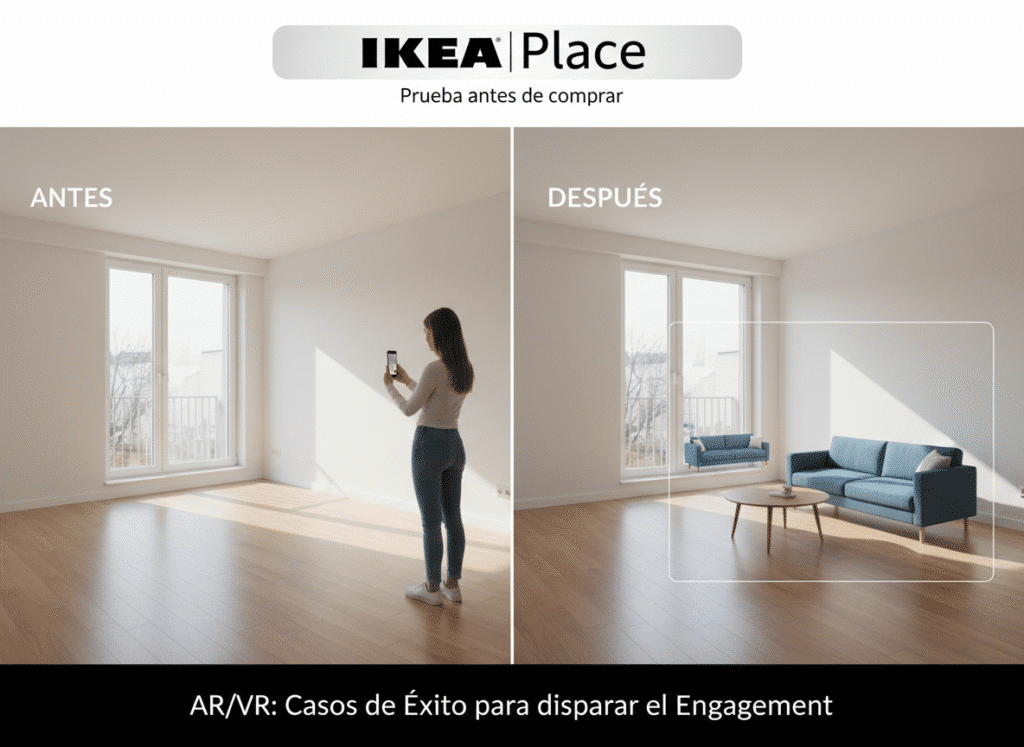
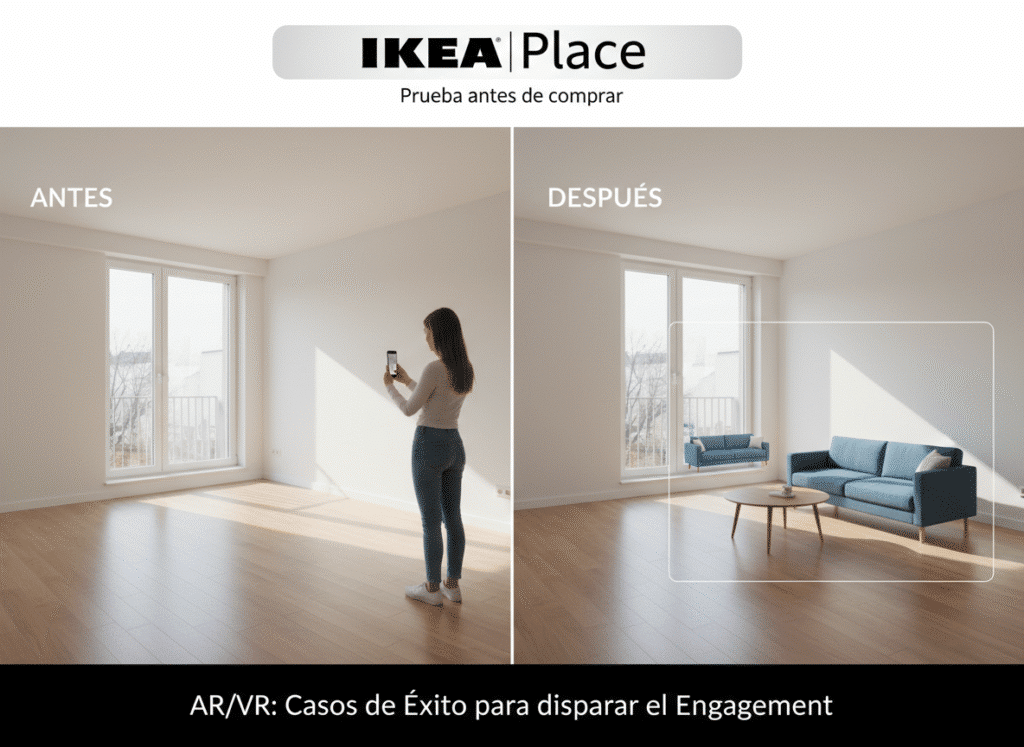
Example: The IKEA Place app allows customers to digitally place life-sized furniture in their own homes before purchase.
Engagement: Reduces purchasing uncertainty, increases confidence, and extends interaction time with the app.
Fashion and Beauty: Instant Transformation (AR)
Example: Virtual try-on tools from L’Oréal or Sephora allow users to «try on» thousands of makeup shades in real-time using their camera.
Engagement: Turns the selection process into an interactive and practical game, increasing conversion rates.
Corporate Training and Safety (VR)
Example: Logistics and manufacturing companies use VR to simulate risk scenarios or the handling of heavy machinery.
Engagement: Immersive training improves information retention by up to 75% compared to traditional methods, creating better-prepared and more committed employees.
Travel and Hospitality: Anticipated Journey (VR)
Example: Travel agencies offer virtual tours of hotels or tourist destinations (such as a walk through a luxury resort or a museum).
Engagement: Generates desire and familiarity before booking, increasing the likelihood of purchase.
Entertainment Marketing: Playful Experiences (AR)
Example: Instagram/Snapchat filters for movies or series (e.g., a Disney character, a Marvel filter) that allow fans to interact directly with the intellectual property.
Engagement: Encourages active participation and viral promotion of the content.
Automotive: Detailed Visualization (AR)
Example: Brands like BMW or Porsche use AR applications to let customers explore vehicle models, customize colors, and view the engine in 3D.
Engagement: Offers a detail-rich experience that drives the purchasing decision.
Immersive Education: Active Learning (AR/VR)
Example: AR applications that overlay information (like constellation names or parts of a cell) onto real objects, or VR models that allow for virtual body dissection.
Engagement: Makes learning multisensory, which positively impacts comprehension and memorization.
Keys to a Successful AR/VR Campaign
For an immersive initiative to achieve high Engagement, it must fulfill three fundamental pillars:
Accessibility: The experience must be easy to access (ideally via a standard smartphone, without the need for expensive hardware) and the loading time must be minimal.
Relevance: The AR/VR content must solve a real user problem or provide clear value (e.g., save time, inform better, entertain).
Narrative (Storytelling): The best immersive experiences tell a story or have a clear purpose, rather than just being a technological demonstration.
Optimization for Featured Snippets
How do Augmented and Virtual Reality impact Engagement?
Augmented and Virtual Reality impact Engagement by converting the user from a passive recipient to an active participant. They offer immersive, personalized, and highly interactive experiences that strengthen the emotional connection with the brand. This is achieved by allowing virtual product try-on, simulated training, or content exploration in a multisensory and memorable way.
The implementation of these technologies is shifting from being an advantage to a necessity, especially among Generation Z and Millennials, who value high-quality digital interaction. The Return on Investment (ROI) is measured not only in direct sales but also in the reduction of user friction and the increase in time spent interacting with the brand.
Conclusion
The AR/VR success stories unequivocally demonstrate that immersion is the future of Engagement. From optimizing the purchasing process in Retail to improving workplace safety in industrial sectors, these technologies offer tangible and exciting solutions. By prioritizing the user experience and providing tools that add real value, companies not only capture attention but also cultivate lasting loyalty. The key is not to use the technology just for the sake of it, but to integrate it strategically to elevate the connection with your audience.
Do you want your brand to be the next AR/VR success story? Our team of experts is ready to help you design and implement immersive experiences that will skyrocket your audience’s Engagement. Contact us for a personalized strategy!