Los anuncios ya no funcionan: qué están haciendo diferente las marcas hoy

Los anuncios tradicionales ya no bastan. Descubre cómo el marketing inmersivo y la brand experience están transformando la conexión con los consumidores. Los anuncios ya no funcionan como antes. Durante años, las marcas confiaron en pautas digitales, banners y comerciales para captar la atención del consumidor, pero hoy ese modelo está perdiendo efectividad. Los usuarios están saturados de mensajes publicitarios, utilizan bloqueadores de anuncios y, sobre todo, ignoran aquello que no les genera valor real. En este nuevo escenario, las marcas que destacan no son las que gritan más fuerte, sino las que crean experiencias memorables. Aquí es donde entran en juego el marketing inmersivo y la brand experience, estrategias que buscan involucrar emocionalmente al consumidor en lugar de interrumpirlo. Pero ¿por qué ya no basta con hacer anuncios? ¿Qué están haciendo diferente las marcas que sí logran conectar, vender y fidelizar? En este artículo descubrirás cómo está cambiando el marketing y por qué las experiencias inmersivas se han convertido en la nueva ventaja competitiva. ¿Por qué los anuncios tradicionales están perdiendo efectividad? Saturación publicitaria y fatiga del consumidor Los usuarios ven miles de anuncios al día. Esta sobreexposición provoca rechazo, desinterés y desconfianza hacia las marcas que solo intentan vender sin conectar. Menor atención y mayor control del usuario Hoy el consumidor decide qué ver, cuándo y cómo. Plataformas sin anuncios, contenido bajo demanda y filtros publicitarios han reducido drásticamente el impacto de la publicidad tradicional. Falta de conexión emocional Los anuncios informan, pero rara vez generan vínculos. Sin una experiencia significativa, el mensaje se olvida rápidamente. Marketing inmersivo: la respuesta al nuevo consumidor El marketing inmersivo va más allá de mostrar un mensaje: busca que el consumidor lo viva. A través de experiencias interactivas, sensoriales y participativas, las marcas logran una conexión mucho más profunda. ¿Qué caracteriza al marketing inmersivo? Participación activa del usuario Uso de tecnología y storytelling Experiencias memorables y compartibles Alto impacto emocional En lugar de interrumpir, este enfoque invita al consumidor a ser parte de la historia. Brand experience: cuando la marca se siente, no solo se ve La brand experience se centra en cómo una persona percibe una marca en cada punto de contacto. No se trata solo de un logo o un anuncio, sino de sensaciones, emociones y recuerdos. Algunas acciones clave incluyen: Activaciones presenciales y digitales Experiencias interactivas con productos Eventos inmersivos y personalizados Contenido que conecta con valores y estilo de vida Las marcas que apuestan por la experiencia no solo venden más, sino que construyen relaciones duraderas. ¿Qué están haciendo diferente las marcas hoy? Crean experiencias en lugar de anuncios Involucran al consumidor como protagonista Apelan a emociones, no solo a beneficios Generan momentos compartibles y memorables Construyen comunidad, no solo alcance Estas marcas entienden que la atención ya no se compra: se gana. En un mundo donde los anuncios tradicionales pierden impacto, el marketing inmersivo y la brand experience se han convertido en la nueva forma de conectar con las audiencias. Las marcas que entienden este cambio dejan de interrumpir y comienzan a crear valor real a través de experiencias. Si quieres que tu marca deje de pasar desapercibida y empiece a ser recordada, el camino no está en hacer más anuncios, sino en crear experiencias que se vivan y se sientan. ¿Listo para ir más allá de la publicidad tradicional? Descubre cómo el marketing inmersivo puede transformar la experiencia de tu marca y conectar de verdad con tus clientes.
What makes a digital experience real?

Real digital experiences: How do we make them work? What makes a digital experience feel real? At Hyper Reality Company, we know that the line between the physical and the virtual is becoming increasingly blurred. A real digital experience is not just a 3D environment; it is an ecosystem where technology disappears to make way for a sense of presence. For them to work, they must be fluid, intuitive, and, above all, emotionally resonant. Have you ever wondered why some immersive platforms leave you indifferent while others completely transport you? In this article, we share our vision on the pillars that transform a common interface into an alternate reality that connects with the user on a deep level. The pillars of digital hyperreality To get the brain to accept a digital environment as “real,” we apply these fundamental principles: 1. Zero Latency and Haptic Feedback In the real world, action and reaction are simultaneous. In our Extended Reality (XR) solutions, we minimize latency so that every user movement has an immediate response, reinforced by vibrations or sounds that confirm the interaction. 2. Visual Fidelity and Light Consistency 4K models are not enough. The key is how light interacts with objects. The use of ray tracing and dynamic shadows is what allows a virtual object to appear to occupy real physical space. 3. Spatial Audio: The Forgotten Sense Sound is 50% of immersion. We implement positional audio that changes according to the user’s orientation, allowing the brain to “locate” objects in a three-dimensional space. Transforming sectors: Applied reality As specialists in creating these environments, we have observed how this technology is redefining businesses: Immersive Retail: We enable customers to not only view products, but also interact with them in their own environment using high-fidelity Augmented Reality (AR). Industrial Training: We create simulators where mistakes have no physical consequences, but learning feels completely authentic thanks to total immersion.Digital Real Estate: Tours where you can feel the volume of spaces and the incidence of sunlight before the first brick is laid. Key Fact: According to internal studies by Hyper Reality Company, high-fidelity immersive experiences increase information retention by 70% compared to traditional digital methods. Checklist: How to elevate your digital project If you want your next experience to feel more human and real, make sure you meet these points: Response speed: Optimize every millisecond of loading time so as not to break the illusion.Natural interactivity: Design interfaces that follow the natural gestures of the human body.Intelligent context: Use AI to make the environment react to user preferences organically.Asset optimization: Use optimized 3D models with alternative text (e.g., Hyper Reality Company simulator showing 3D engine) to improve SEO and accessibility. Conclusion Ultimately, digital experiences that feel real are the result of a perfect blend of cutting-edge engineering and design psychology. At Hyper Reality Company, our mission is to continue pushing the boundaries of what is possible so that your brand is not only seen, but experienced. Do you want to lead the next digital revolution?Explore our projects and discover how we can transform your vision into a tangible reality.
Make Your Brand Look Innovative Without Changing Your Product

Discover how immersive experiences with AR, VR, and 3D make your brand feel innovative without changing the product you sell. Some brands always seem to be one step ahead. Not because they have better products, but because they communicate differently. The perception of innovation doesn’t always come from the product itself. Many times, it comes from the experience — how users interact with, discover, and remember a brand. That’s where immersive experiences come in. Today, technologies like augmented reality (AR), virtual reality (VR), and 3D visualization allow brands to transform how they present themselves without changing what they sell. The product stays the same, but the experience around it becomes more modern, memorable, and distinctive. This isn’t about looking futuristic for the sake of trends.It’s about communicating value in a way the consumer’s brain associates with innovation. In this article, you’ll learn: Why some brands are perceived as more innovative than others How AR, VR, and 3D change perception without touching the product What types of immersive experiences create that effect The key question is simple:Does your brand feel current — or does it feel outdated? Why Are Some Brands Perceived as More Innovative? Because they understand one key idea:perception matters as much as the product itself. Brands that feel “ahead of their time” usually: Communicate in interactive ways Use technology to make decisions easier for customers Create experiences, not just messages They don’t sell differently.They present themselves differently. Immersive Experiences: What They Are and Why They Work Immersive experiences allow users to: Explore Interact Make decisions actively Instead of just seeing a brand, they experience it. AR, VR, and 3D work because they involve users directly, activating curiosity, attention, and memory — exactly what the brain interprets as innovation. Benefits of Using Immersive Experiences for Your Brand Immediate perception of innovation Higher engagement Clear differentiation from competitors Memorable experiences Stronger brand recall It’s not about changing what you sell.It’s about changing how people experience it. AR: Innovation Visible in the Real World Augmented reality overlays products or information onto the user’s real environment. This creates: Immediate impact A sense of modernity Greater confidence before purchasing The product doesn’t change.The experience does. VR: Taking the User to the Next Level Virtual reality creates fully immersive environments where the brand controls the narrative. It’s ideal for: Product launches Premium experiences Complex demonstrations A brand that uses VR is automatically perceived as advanced. 3D: Clarity, Control, and Modernity 3D visualization allows products to be shown with detail, movement, and full user control. Key benefits: Better product understanding Fewer doubts A feeling of precision and innovation 3D doesn’t just explain.It elevates brand perception. What are immersive experiences in marketing?They are interactive experiences using AR, VR, or 3D that engage users and improve a brand’s perception of innovation. Looking innovative isn’t about budget.It’s about experience. Discover how immersive experiences with AR, VR, and 3D can transform how your brand is perceived — without changing your product. Brands that seem to live in the future don’t always have better products.They have better experiences. AR, VR, and 3D allow brands to feel modern, innovative, and relevant without rebuilding their offering — simply by changing how users interact with it. Same product. New perception. More value. Discover more at hyperrealitycompany.com
¿Qué hace real a una experiencia digital?
Experiencias digitales reales: ¿Cómo las hacemos funcionar? ¿Qué hace que una experiencia digital se sienta real? En Hyper Reality Company, sabemos que la línea entre lo físico y lo virtual es cada vez más delgada. Una experiencia digital real no es solo un entorno 3D; es un ecosistema donde la tecnología desaparece para dar paso a la sensación de presencia. Para que funcionen, deben ser fluidas, intuitivas y, sobre todo, emocionalmente resonantes.¿Te has preguntado por qué algunas plataformas inmersivas te dejan indiferente mientras otras te transportan por completo? En este artículo, compartimos nuestra visión sobre los pilares que transforman una interfaz común en una realidad alternativa que conecta con el usuario a un nivel profundo. Los pilares de la hiperrealidad digital Para lograr que el cerebro acepte un entorno digital como «verdadero», aplicamos estos principios fundamentales: 1. Latencia Cero y Respuesta Háptica En el mundo real, la acción y la reacción son simultáneas. En nuestras soluciones de Realidad Extendida (XR), minimizamos la latencia para que cada movimiento del usuario tenga una respuesta inmediata, reforzada por vibraciones o sonidos que confirman la interacción. 2. Fidelidad Visual y Coherencia de Luz No basta con modelos 4K. La clave está en cómo la luz interactúa con los objetos. El uso de ray tracing y sombras dinámicas es lo que permite que un objeto virtual parezca ocupar un espacio físico real. 3. Audio Espacial: El sentido olvidado El sonido es el 50% de la inmersión. Implementamos audio posicional que cambia según la orientación del usuario, permitiendo que el cerebro «ubique» objetos en un espacio tridimensional. Transformando sectores: La realidad aplicada Como especialistas en la creación de estos entornos, hemos observado cómo esta tecnología redefine negocios: Retail Inmersivo: Permitimos que los clientes no solo vean productos, sino que interactúen con ellos en su propio entorno mediante Realidad Aumentada (AR) de alta fidelidad. Formación Industrial: Creamos simuladores donde el error no tiene consecuencias físicas, pero el aprendizaje se siente totalmente auténtico gracias a la inmersión total. Real Estate Digital: Recorridos donde puedes sentir el volumen de los espacios y la incidencia de la luz solar antes de que se coloque el primer ladrillo. Dato Clave: Según estudios internos de Hyper Reality Company, las experiencias inmersivas de alta fidelidad aumentan la retención de información en un 70% comparado con métodos digitales tradicionales. Checklist: Cómo elevar tu proyecto digital Si quieres que tu próxima experiencia se sienta más humana y real, asegúrate de cumplir con estos puntos: Velocidad de respuesta: Optimiza cada milisegundo de carga para no romper la ilusión. Interactividad natural: Diseña interfaces que sigan los gestos naturales del cuerpo humano. Contexto inteligente: Usa la IA para que el entorno reaccione a las preferencias del usuario de forma orgánica. Optimización de activos: Usa modelos 3D optimizados con texto alternativo (ej. Simulador de Hyper Reality Company mostrando motor en 3D) para mejorar el SEO y la accesibilidad. Conclusión En definitiva, las experiencias digitales que se sienten reales son el resultado de una mezcla perfecta entre ingeniería de vanguardia y psicología del diseño. En Hyper Reality Company, nuestra misión es seguir empujando los límites de lo posible para que tu marca no solo sea vista, sino vivida. ¿Quieres liderar la próxima revolución digital? Explora nuestros proyectos y descubre cómo podemos transformar tu visión en una realidad tangible.
Haz que tu marca se vea innovadora sin cambiar tu producto
Descubre cómo las experiencias inmersivas con AR, VR y 3D hacen que tu marca se perciba innovadora sin modificar tu producto. Algunas marcas parecen estar siempre un paso adelante. No porque tengan mejores productos, sino porque se comunican de forma distinta. La percepción de innovación no siempre nace en el producto. Muchas veces nace en la experiencia. En cómo el usuario interactúa, descubre y recuerda a la marca. Ahí es donde entran las experiencias inmersivas. Hoy, tecnologías como realidad aumentada (AR), realidad virtual (VR) y visualización 3D permiten transformar la forma en que una marca se presenta, sin necesidad de cambiar lo que vende. El producto sigue siendo el mismo, pero la experiencia alrededor se vuelve más moderna, memorable y diferenciadora. No se trata de parecer futurista por moda.Se trata de comunicar valor de una forma que el cerebro del consumidor asocie con innovación. En este artículo vas a descubrir: Por qué algunas marcas se perciben más innovadoras que otras Cómo AR, VR y 3D cambian la percepción sin tocar el producto Qué tipo de experiencias inmersivas generan ese efecto La pregunta clave es simple: ¿tu marca se ve actual… o se siente del pasado? ¿Por qué algunas marcas se perciben como más innovadoras? Porque entienden algo clave:la percepción es tan importante como el producto. Las marcas que parecen “del futuro” suelen: Comunicar de forma interactiva Usar tecnología para facilitar la decisión del cliente Crear experiencias, no solo mensajes No venden diferente.Se muestran diferente. Experiencias inmersivas: qué son y por qué funcionan Las experiencias inmersivas permiten que el usuario: Explore Interactúe Decida activamente En lugar de mirar una marca, la vive. AR, VR y 3D funcionan porque involucran al usuario de forma directa, activando curiosidad, atención y memoria. Eso es lo que el cerebro traduce como innovación. Beneficios de usar experiencias inmersivas en tu marca Percepción inmediata de innovación Mayor engagement Diferenciación frente a la competencia Experiencias memorables Mejor recuerdo de marca No se trata de cambiar lo que vendes.Se trata de cambiar cómo lo experimentan. AR: innovación visible en el mundo real La realidad aumentada permite superponer productos o información en el entorno real del usuario. Esto genera: Impacto inmediato Sensación de modernidad Mayor confianza antes de comprar El producto no cambia.La experiencia sí. VR: llevar al usuario a otro nivel La realidad virtual crea entornos completos donde la marca controla la narrativa. Es ideal para: Lanzamientos Experiencias premium Demostraciones complejas Una marca que usa VR se percibe automáticamente como avanzada. 3D: claridad, control y modernidad La visualización 3D permite mostrar productos con detalle, movimiento y control total. Beneficios clave: Mejor comprensión del producto Menos dudas Sensación de precisión e innovación El 3D no solo explica.Eleva la percepción de marca. ¿Qué son las experiencias inmersivas en marketing? Son experiencias interactivas que usan AR, VR o 3D para involucrar al usuario y mejorar la percepción de innovación de una marca. Verse innovador no es cuestión de presupuesto.Es cuestión de experiencia. Descubre cómo las experiencias inmersivas con AR, VR y 3D pueden transformar la percepción de tu marca sin cambiar tu producto. Las marcas que parecen estar en el futuro no siempre tienen mejores productos.Tienen mejores experiencias. AR, VR y 3D permiten que una marca se vea moderna, innovadora y relevante sin rehacer su oferta. Solo cambiando la forma en que el usuario interactúa con ella. Mismo producto. Nueva percepción. Más valor. Discover more at hyperrealitycompany.com
Marketing in shopping malls

Discover how immersive experiences, AR, and FOOH are redefining marketing in shopping malls and helping brands stand out. Capturing attention in shopping malls today is harder than ever. People walk fast, look at their phones, and are exposed to constant stimuli, making traditional advertising easy to ignore. While shopping malls remain important spaces for brands, simply being present is no longer enough. Brands need to stand out by going beyond static ads or booths and creating experiences that truly surprise and engage people. This is where immersive experiences, augmented reality (AR), FOOH, and high-impact interactive activations come into play. These strategies spark curiosity, invite participation, and help brands break through the noise, generate conversation, and improve brand perception. Why Is It So Hard to Capture Attention in Shopping Malls Today? Consumer behavior has changed. Today, people: Are constantly overstimulated Make faster decisions Automatically filter out traditional advertising In shopping malls, this means many messages go unnoticed. Attention is no longer earned by being louder, but by delivering a better experience. Immersive Experiences: When the Brand Is Lived Immersive experiences turn spectators into participants. Instead of simply seeing a brand, people interact with it. These experiences create: Longer engagement time Stronger brand recall Emotional connection In a competitive mall environment, getting someone to stop is already a win. Getting them to engage is real impact. From the Mall to the Feed A strong activation doesn’t stay inside the mall. It continues on social media through stories, reels, and videos shared by visitors themselves. AR and FOOH: Technology That Breaks the Physical Space Augmented reality (AR) and FOOH (Fake Out Of Home) allow brands to push beyond the physical limits of shopping malls. Activations can feel unexpected, even impossible, prompting the question: Is this real? That moment of surprise helps: Capture immediate attention Create highly shareable content Extend reach beyond the physical location High-Impact Interactive Activations Interactive activations invite people to participate, not just observe. Games, challenges, digital installations, and tech-driven experiences encourage active engagement. When people participate: The experience feels personal The message is easier to understand The brand feels innovative Why Do These Strategies Work Better Than Traditional Advertising? Because they don’t interrupt. Because they spark curiosity. Because they turn ordinary spaces into unexpected experiences. In saturated shopping malls, brands that invest in immersive experiences, AR, and FOOH don’t compete for attention they attract it naturally. This is where immersive experiences, augmented reality (AR), FOOH, and high-impact interactive activations come in. At Hyperreality, we design these kinds of experiences to help brands stand out in crowded physical spaces, combining creativity and technology to transform shopping malls into moments that people stop to experience, remember, and share. Success Story: Collaboration with New Era: 3D Advertising That Transforms the Mall Experience As part of its approach to helping brands stand out in crowded physical spaces, Hyperreality Company partnered with New Era on a 3D advertising campaign for a digital screen located in one of Guatemala’s busiest shopping malls. This project combined creativity and technology to design a three-dimensional visual piece that not only captured visitors’ attention but also enhanced the shopping experience, making it more interactive and memorable. Through advanced visual effects, the campaign successfully reflected the brand’s essence in a striking way, helping it stand out from traditional advertising noise and strengthen its presence in a highly competitive environment. Discover at hyperrealitycompany.com
Marketing en centros comerciales
Aprende cómo destacar en centros comerciales saturados usando experiencias inmersivas, interactivas y realidad aumentada Captar la atención en centros comerciales hoy es más difícil que nunca. Las personas caminan rápido, miran el celular y están expuestas a demasiados estímulos, haciendo que la publicidad tradicional pase desapercibida. Aunque los centros comerciales siguen siendo espacios clave para las marcas, el reto ya no es solo estar presentes, sino destacar. Para lograrlo, las marcas necesitan ir más allá de un stand o una valla publicitaria y apostar por experiencias que realmente sorprendan e involucren al público. Aquí es donde entran las experiencias inmersivas, la realidad aumentada (AR), el FOOH y las activaciones interactivas de alto impacto. Estas estrategias despiertan curiosidad, invitan a participar y ayudan a romper el ruido, generar conversación y mejorar la percepción de marca. ¿Por qué es tan difícil captar la atención en centros comerciales hoy? Los hábitos del consumidor han cambiado. Hoy las personas: Están hiperestimuladas Toman decisiones rápidas Filtran automáticamente la publicidad tradicional En un centro comercial, esto se traduce en mensajes ignorados y activaciones que pasan desapercibidas. La atención ya no se gana por volumen, sino por experiencia. Experiencias inmersivas: cuando la marca se vive Las experiencias inmersivas transforman al espectador en participante. En lugar de observar una marca, las personas interactúan con ella. Estas experiencias generan: Mayor tiempo de interacción Recuerdo de marca más fuerte Conexión emocional En un espacio tan competitivo como un centro comercial, lograr que alguien se detenga ya es una victoria. Lograr que participe, es impacto real. Del impacto visual a la experiencia memorable No se trata solo de algo bonito o llamativo, sino de crear momentos que las personas quieran recordar… y compartir. AR y FOOH: tecnología que rompe el entorno físico La realidad aumentada (AR) y el FOOH (Fake Out Of Home) permiten romper los límites del espacio físico del centro comercial. Una activación puede parecer imposible, sorprender y generar duda: ¿esto es real? Ese momento de sorpresa es clave para: Captar atención inmediata Generar contenido para redes sociales Amplificar el alcance más allá del lugar físico Activaciones interactivas de alto impacto Las activaciones interactivas invitan a las personas a participar, no solo a mirar. Juegos, retos, experiencias digitales o instalaciones tecnológicas hacen que el público se involucre activamente con la marca. Cuando el consumidor participa: La experiencia se vuelve personal El mensaje se entiende mejor La marca se percibe como innovadora ¿Por qué estas estrategias funcionan mejor que la publicidad tradicional? Porque no interrumpen.Porque generan curiosidad.Porque convierten un espacio común en una experiencia inesperada. En centros comerciales saturados, las marcas que apuestan por experiencias inmersivas, AR y FOOH no compiten por atención: la atraen naturalmente. Captar la atención en centros comerciales hoy es más difícil que nunca. Las personas caminan rápido, miran el celular y están expuestas a demasiados estímulos, lo que hace que la publicidad tradicional pase desapercibida. Aunque siguen siendo espacios clave para las marcas, ya no basta con estar presentes: hay que destacar. Aquí es donde entran las experiencias inmersivas, la realidad aumentada (AR), el FOOH y las activaciones interactivas de alto impacto. En Hyperreality diseñamos este tipo de experiencias para ayudar a las marcas a sobresalir en espacios físicos saturados, combinando creatividad y tecnología para transformar centros comerciales en momentos que las personas se detienen a vivir, recordar y compartir. Caso de éxito: Colaboración con New Era: publicidad 3D que transforma la experiencia en centros comercialesComo parte de su enfoque para ayudar a las marcas a destacar en espacios físicos saturados, Hyperreality Company trabajó junto a New Era en una campaña de publicidad en 3D para una pantalla digital ubicada en uno de los centros comerciales más concurridos de Guatemala. Este proyecto combinó creatividad y tecnología para diseñar una pieza visual tridimensional que no solo captó la atención de los visitantes, sino que también enriqueció la experiencia de compra al hacerla más interactiva y memorable. A través de efectos visuales avanzados, la campaña logró reflejar la esencia de la marca de manera impactante, ayudando a diferenciarla del ruido publicitario tradicional y potenciar su presencia en un entorno altamente competitivo. Descubre más en hyperrealitycompany.com
AI Agents in 2026: The Future of Business Automation

Discover how AI agents in 2026 are transforming business automation and decision-making across modern companies. AI agents in 2026 are marking a turning point in how companies operate. They are no longer simple assistants that answer questions, but systems capable of analyzing information, making decisions, and executing actions on their own. In an increasingly fast-paced and competitive digital environment, AI agents help businesses optimize processes, reduce errors, and scale operations without growing teams. That’s why they are being adopted across areas like marketing, sales, customer support, and operations. But what truly sets an AI agent apart from traditional automation? And why is this technology becoming so relevant for companies today? In this article, we break down what AI agents are and why they are shaping the future of work What Is an AI Agent in 2026? An AI agent is a system designed to perceive information, interpret context, make decisions, and take action to achieve a specific goal. In 2026, AI agents go far beyond basic automation by learning from interactions and continuously improving their performance. Unlike traditional workflows, AI agents can: Prioritize tasks Solve complex problems Coordinate with other tools and systems Adapt to changing conditions This ability to act independently is what makes them so powerful for modern businesses. AI Agents vs. Traditional Chatbots Although they are often confused, AI agents and chatbots are not the same. Chatbots: Answer predefined questions Follow rigid conversation flows Depend on rules and scripts AI agents: Understand context and intent Make autonomous decisions Execute real actions Learn and improve over time The key difference is simple: chatbots respond, while AI agents take action. From Responding to Executing The real breakthrough happens when AI stops being conversational only and starts becoming operational sending emails, updating systems, generating reports, or triggering workflows without human intervention. Key Use Cases for AI Agents in Business In 2026, AI agents are already being used across multiple departments: Marketing: campaign optimization, performance analysis, content personalization Sales: lead qualification, follow-ups, forecasting Customer support: resolving complex issues with minimal human input Operations: process optimization, inventory tracking, error detection Their value lies in removing repetitive work and allowing teams to focus on higher-level decisions. Intelligent Automation, Not Mechanical Automation AI agents don’t just automate tasks they adapt to each situation, learn from outcomes, and continuously optimize how work gets done. Why AI Agents Will Be Essential in 2026 Companies today face three major challenges: lack of time, information overload, and the need to scale efficiently. AI agents directly address all three. They help businesses: Make faster decisions Reduce human error Scale operations without growing teams Improve customer experiences AI Agents and the Future of Work AI agents are changing how teams work—not by replacing people, but by giving time back. By handling repetitive and operational tasks, they allow professionals to focus on strategy, creativity, and problem-solving. A clear example of this evolution is Shifu, the AI assistant created by Hyperreality Company. Built around a simple idea «time is gold» Shifu is designed to give every second back to its users. Through personalized training, Shifu learns how each person works and adapts to their workflow. By 2026, AI agents are no longer a future promise they are practical tools already transforming how businesses operate. Their ability to learn, adapt, and execute tasks makes them essential allies for working smarter, scaling efficiently, and staying competitive in an increasingly demanding market. Discover more at hyperrealitycompany.com
Agentes de IA en 2026: el futuro de la automatización empresarial
Descubre cómo los agentes de IA en 2026 están transformando la automatización empresarial y la toma de decisiones en las empresas. Los agentes de IA en 2026 ya no son una idea del futuro: son una realidad que está redefiniendo cómo las empresas operan, toman decisiones y escalan sus procesos. A diferencia de los chatbots tradicionales, estos agentes no solo responden preguntas, sino que actúan, aprenden y ejecutan tareas de forma autónoma. En un entorno donde la velocidad, la eficiencia y la personalización marcan la diferencia, los agentes de inteligencia artificial se han convertido en aliados clave para equipos de marketing, ventas, operaciones y atención al cliente. Su capacidad para analizar datos en tiempo real y tomar decisiones sin intervención humana está cambiando las reglas del juego. Pero, ¿qué hace que un agente de IA sea realmente útil en 2026? ¿Cómo se integran en los flujos de trabajo actuales? ¿Y por qué cada vez más empresas están apostando por este tipo de tecnología? En este artículo exploramos qué son los agentes de IA, cómo funcionan hoy y por qué se perfilan como una de las herramientas más importantes para las empresas en los próximos años. ¿Qué es un agente de IA y cómo funciona en 2026? Un agente de IA es un sistema capaz de percibir información, tomar decisiones y ejecutar acciones para cumplir un objetivo específico. En 2026, estos agentes son mucho más avanzados: entienden contexto, se adaptan al comportamiento del usuario y aprenden con cada interacción. A diferencia de una automatización básica, un agente de IA puede: Priorizar tareas Resolver problemas complejos Coordinarse con otros sistemas Mejorar su desempeño con el tiempo Diferencia entre agentes de IA y chatbots tradicionales Aunque suelen confundirse, no son lo mismo. Los chatbots: Responden preguntas predefinidas Siguen flujos rígidos Dependen de reglas claras Los agentes de IA: Analizan contexto y datos Toman decisiones autónomas Ejecutan acciones reales Aprenden y se optimizan Esta diferencia es clave para entender por qué los agentes de IA están ganando protagonismo en 2026. De responder a ejecutar El verdadero salto ocurre cuando la IA deja de solo “hablar” y empieza a hacer: enviar correos, actualizar sistemas, generar reportes o tomar decisiones operativas. Casos de uso de agentes de IA en empresas: En 2026, los agentes de IA se usan en múltiples áreas: Marketing: optimización de campañas, análisis de resultados, personalización de contenido Ventas: calificación de leads, seguimiento automático, predicción de cierres Atención al cliente: resolución de problemas complejos sin intervención humana Operaciones: gestión de inventarios, análisis de procesos, detección de errores Su valor está en reducir fricción y liberar tiempo para tareas estratégicas. Automatización inteligente, no mecánica La diferencia no es solo automatizar, sino hacerlo de forma inteligente, adaptándose a cada situación y mejorando con el uso. ¿Por qué los agentes de IA serán clave en 2026? Las empresas enfrentan tres grandes retos: falta de tiempo, exceso de datos y necesidad de escalar sin aumentar costos. Los agentes de IA responden directamente a estos problemas. Permiten: Tomar decisiones más rápidas Reducir errores humanos Escalar operaciones sin crecer el equipo Mejorar la experiencia del cliente ¿Por qué los agentes de IA serán clave en 2026? Las empresas enfrentan tres grandes retos: falta de tiempo, exceso de datos y necesidad de escalar sin aumentar costos. Los agentes de IA responden directamente a estos problemas. Permiten: Tomar decisiones más rápidas Reducir errores humanos Escalar operaciones sin crecer el equipo Mejorar la experiencia del cliente Agentes de IA y el futuro del trabajo Los agentes de IA están redefiniendo la forma en que trabajamos. No vienen a reemplazar personas, sino a recuperar tiempo: automatizan tareas repetitivas y permiten que los equipos se enfoquen en lo que realmente genera valor. Un ejemplo de este enfoque es Shifu, la asistente de IA creada por Hyperreality Company. Bajo una idea simple «el tiempo es oro» Shifu está pensada para devolverle a los equipos cada segundo perdido en tareas operativas. A través de entrenamiento personalizado, Shifu aprende cómo trabaja cada usuario y se adapta a sus necesidades. Los agentes de IA en 2026 representan una evolución natural de la inteligencia artificial aplicada a negocios. Su capacidad para actuar, aprender y adaptarse los convierte en una herramienta clave para las empresas que buscan eficiencia, crecimiento y ventaja competitiva en un mercado cada vez más exigente. Descubre más en hyperrealitycompany.com
AI Agents: Automated Project Management
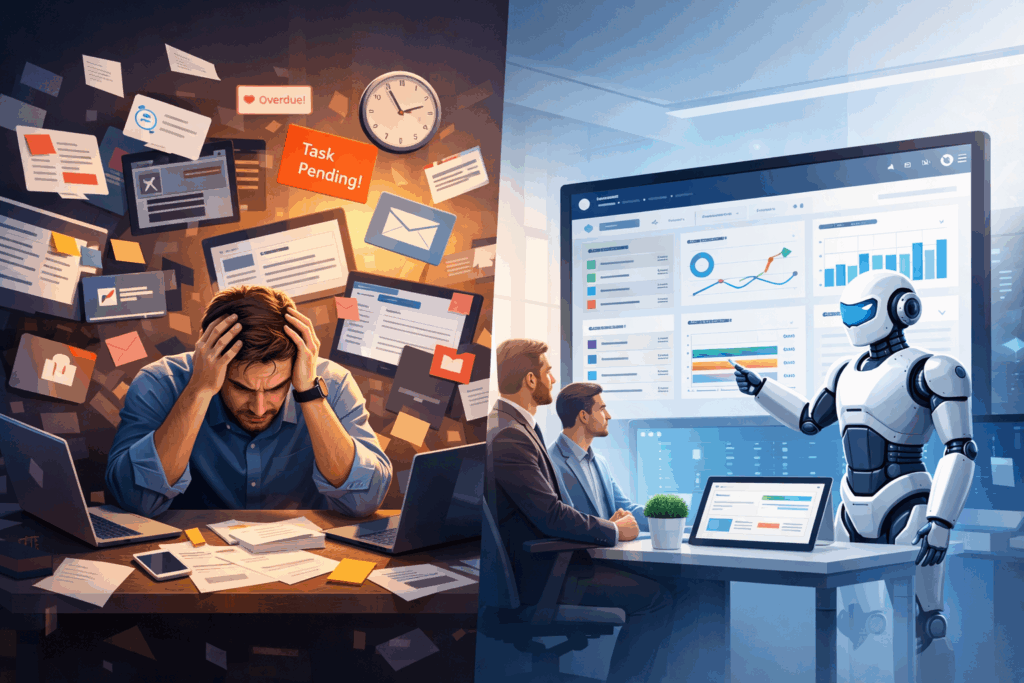
Discover how AI-powered agents can automate project management, boost team productivity, and deliver results faster with Shifu. AI agents are no longer science fiction. They’re your new secret weapon to automate project management and boost productivity. Managing projects traditionally means juggling timelines, resources, tasks, and teams. While it’s possible, it’s not efficient. Human managers can only track so many things at once, and as the workload increases, so does the risk of burnout, errors, and delays. That’s where Shifu comes in. With AI-driven agents, your projects become automated. Tasks are assigned, deadlines are met, and bottlenecks are identified automatically. The best part? You can free up time for your team to focus on creative, high-value tasks while the AI handles the rest. In this article, you’ll learn: How AI agents transform project management Why automating workflows boosts productivity How Shifu’s AI agents deliver measurable results The question is simple:Are you still managing projects manually, or are you ready to let AI do the work for you? Why Project Management Is Hard Without AI Managing a project involves countless moving parts: Task delegation Resource allocation Deadline tracking Communication flow The problem is simple: human error.As teams grow and projects get more complex, it becomes harder to keep everything aligned. What Are AI Agents and How Do They Work? AI agents are software tools powered by artificial intelligence designed to automate repetitive tasks and help with decision-making. They take over the administrative part of project management, such as: Assigning tasks based on team member availability and skills Tracking progress and identifying potential delays Recommending adjustments for improved efficiency Shifu uses AI agents to seamlessly manage projects without constant manual intervention. AI-Driven Automation for Task Management The main benefit of AI is its ability to manage workflows without human input. It can: Prioritize tasks based on project urgency Automatically reassign tasks if deadlines slip Ensure resources are allocated properly, preventing bottlenecks With AI managing these tasks, your team can focus on more critical, high-level work. Improving Team Efficiency with AI Agents AI agents can enhance productivity by: Reducing the administrative burden on project managers Ensuring that tasks are completed on time Predicting issues before they arise, preventing project delays Enabling teams to collaborate more effectively with real-time updates and automated alerts AI doesn’t just help with automation; it actively improves team efficiency. Key Benefits of Using Shifu for Project Management Faster project completion times Reduced human error and risk Improved collaboration and communication Streamlined task management Real-time tracking and predictive insights AI isn’t just a tool. It’s a way to supercharge your team’s productivity. Measuring the Impact of AI on Productivity The ROI of AI in project management can be measured by: Time saved by automating administrative tasks Increased team output due to better resource allocation Faster decision-making with AI-powered insights Fewer project delays and disruptions When you free up your team from tedious tasks, the results speak for themselves. What are AI agents in project management? AI agents are tools powered by artificial intelligence that automate tasks, manage workflows, and optimize project management, improving efficiency and productivity. Managing projects the traditional way is a thing of the past.It’s time to let AI take over. Learn how Shifu can automate your project management and boost your team’s productivity today. Project management doesn’t have to be hard.It doesn’t have to be manual either. AI agents from Shifu transform the way projects are managed. They take care of the repetitive tasks, so your team can focus on the work that truly matters. More efficiency. Less effort. Better results. Discover more at hyperrealitycompany.com
