Gamification and dopamine: how interactive content dominates digital marketing

What really dominates nowadays

How interactive content dominates marketing

Gamification and dopamine 

Today we compete in the attention economy. Content that truly works isn’t the longest or most technical, but the kind that triggers dopamine, satisfaction, and active participation. In this scenario, gamification stopped being a trend and became a standard.

Why is everything gamifiable today?

Gamification works because it aligns with how the human brain responds to stimuli. Mechanics such as progress, rewards, challenges, and immediate feedback activate dopamine pathways, reinforcing motivation, engagement, and a sense of achievement, which encourages users to stay longer and participate repeatedly.

Key Factors:

  • Need for immediate gratification
  • Saturation of traditional content
  • Lower tolerances for complex interfaces
  •  Preference for dynamic and visual experiences

Gamifying is not about playing games; it’s about designing experiences that feel satisfying.

Dopamine and digital content: the new invisible metric

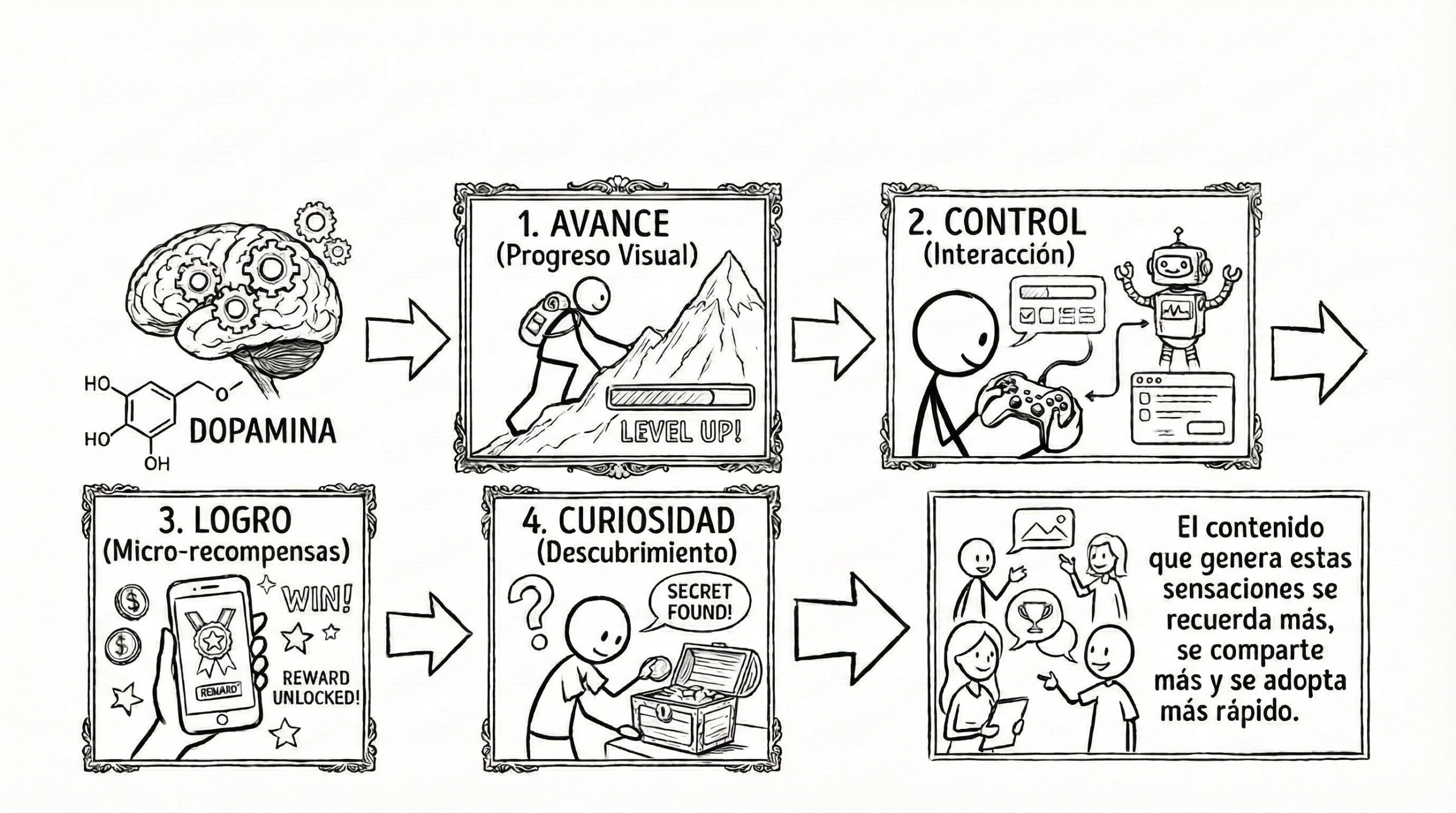
Dopamine is activated when the user experiences:

  • Progress (visual progression)

  • Control (interaction)

  • Achievement (micro-rewards)

  • Curiosity (discovery)

Content that generates these sensations is remembered more, shared more, and adopted more quickly.


From static content to interactive experiences

Traditional content is passive. Modern content is participatory.

Content evolution:

Long text → visual experiences

PDFs → interactive interfaces

Technical explanations → visual storytelling

Reading → exploration

When something is visual and interactive, it reduces cognitive friction and accelerates understanding.

Hyper and gamification applied to real-world experiences

At Hyper, we design products that turn complex processes into clear, visual, and intuitive experiences. We don’t aim to display information, but to activate emotions and actions.

Our products:


  • Transform information into interactive experiences

  • Use visuals as a tool for understanding

  • Reduce friction in technology adoption

  • Generate real engagement, not superficial engagement

Gamification is part of the design, not an add-on.

Conclusion: the future of content is experiential

In a world where everything competes for dopamine, the brands that win aren’t the ones that talk the most, but the ones that design better experiences.

Content is no longer consumed.

It is experienced.

And that’s the game we’re building at Hyper.

Facebook
Twitter
LinkedIn

Contactanos:

Gamification and dopamine: how interactive content dominates digital marketing

Gamification and dopamine: how interactive content dominates digital marketing

What really dominates nowadays

How interactive content dominates marketing

Gamification and dopamine 

Today we compete in the attention economy. Content that truly works isn’t the longest or most technical, but the kind that triggers dopamine, satisfaction, and active participation. In this scenario, gamification stopped being a trend and became a standard.

Why is everything gamifiable today?

Gamification works because it aligns with how the human brain responds to stimuli. Mechanics such as progress, rewards, challenges, and immediate feedback activate dopamine pathways, reinforcing motivation, engagement, and a sense of achievement, which encourages users to stay longer and participate repeatedly.

Key Factors:

  • Need for immediate gratification
  • Saturation of traditional content
  • Lower tolerances for complex interfaces
  •  Preference for dynamic and visual experiences

Gamifying is not about playing games; it’s about designing experiences that feel satisfying.

Dopamine and digital content: the new invisible metric

Dopamine is activated when the user experiences:

  • Progress (visual progression)

  • Control (interaction)

  • Achievement (micro-rewards)

  • Curiosity (discovery)

Content that generates these sensations is remembered more, shared more, and adopted more quickly.


From static content to interactive experiences

Traditional content is passive. Modern content is participatory.

Content evolution:

Long text → visual experiences

PDFs → interactive interfaces

Technical explanations → visual storytelling

Reading → exploration

When something is visual and interactive, it reduces cognitive friction and accelerates understanding.

Hyper and gamification applied to real-world experiences

At Hyper, we design products that turn complex processes into clear, visual, and intuitive experiences. We don’t aim to display information, but to activate emotions and actions.

Our products:


  • Transform information into interactive experiences

  • Use visuals as a tool for understanding

  • Reduce friction in technology adoption

  • Generate real engagement, not superficial engagement

Gamification is part of the design, not an add-on.

Conclusion: the future of content is experiential

In a world where everything competes for dopamine, the brands that win aren’t the ones that talk the most, but the ones that design better experiences.

Content is no longer consumed.

It is experienced.

And that’s the game we’re building at Hyper.

Facebook
Twitter
LinkedIn
Facebook
Twitter
LinkedIn

Contactanos:

Contactanos: